Pages

Showing posts with label WW1. Show all posts

Tuesday, 29 December 2015

Latest Additions: October Show Acquisitions

Another collecting year very nearly over and what better way to round it off than with a couple of posts highlighting some additions to my own collection

First up, a delightfully posed WW1 sniper by JJD to add to my, as yet still very small, collection of his figures. This particular figure will take his place in my WW1 diorama, just about to take refuge in a somewhat wet shell hole ready for his next shot


Going back a little further in time, an ensemble of half a dozen Austrian figures from the Seven Years War that I picked up at the 2015 Birmingham Toy Soldier Show in October. Thanks to Barry at Piers Christian who was selling them off at a significantly discounted price. I couldn't pass up the opportunity of giving my Prussians something to shoot at as they pressed their advantage at Leuthen


Finally, a figure I bought recently from Sierra Toy Soldiers in California, a retired hitler figure, and one of several I have now, from K&C. He is one of a number of retired figures I bought at the same time, about which more in the next post


Happy Hunting!

Saturday, 25 July 2015

John Jenkins Designs: July Germans


Just the one entry for JJD this month, a dramatic depiction of a rather spectacular fall from grace for a WW1 German pilot in the shape of this crashed Eindecker!

New July Releases!
Knights Of The Skies


The tactical, technological and training differences between Germany and the allied forces, ensured the British suffered a casualty rate nearly four times as great as their opponents. The losses were so disastrous that it threatened to undermine the morale of entire squadrons.
Royal Flying Corps (RFC) pilot training was often cursory, especially in the early days of the war. Many recruits had only 2 to 3 hours of flying instruction before being expected to fly solo. Men were often sent to France having logged only 15 hours in the air. 8000 young men died in Britain during flight training, which means that more died from accidents and equipment failures than from enemy action.
Most RFC pilots lasted only an average of about 3 weeks once they arrived at the Western Front. Those who weren't killed, wounded, or taken prisoner might be posted out because of "nerves". Flying was extremely stressful and dangerous. Those who lived through the first few weeks acquired skills that helped them live longer or even survive the war.
RFC pilots were not allowed to use parachutes, although the men who were up in observation balloons had them and often used them to escape an attack. Towards the end of the war, German pilots were using parachutes.
According to H.A.Jones' War in the Air, a study of the UK's Royal Flying Corps in WW1, the amount of time a pilot could expect to fly before becoming a casualty (killed, wounded, or psychiatric) was a low of 92 hours in April 1917, and a high of 295 hours in August 1916. Note, in particular, that a much higher percentage of pilots became psychiatric casualties (modern-day PTSD) than would otherwise be expected (as high as 25% of all casualties), due to the radically higher stress of combat flight. Given that a typical combat flight lasted an hour or two at most, with an average number of mission at less than 1 per day, a pilot would last at least 4 weeks before becoming a casualty, to as many as 5 months.


Happy Hunting!

William Britain: July Germans

The latest German releases for the First World War, Western Front theatre, with a focus this time on some of the goings on 'behind the lines'.

WWI German Forces 1916 -1918


WWI German Forces 1916 -1918


Happy Hunting!

Friday, 24 July 2015

King and Country: July Dispatches


A small selection of the German releases from K&C in July. Further information and images from the usual places; the company website and TSC to name but two


Happy Hunting!

John Jenkins Designs: June Germans


WWI - German Army

Although Germany was slow to develop its own tank force, there was a need to produce a range of methods aimed at neutralizing the effect of the Allied armour. This included concentrated charges, armour piercing bullets, individual field guns in a close combat role, and finally anti tank rifles.
Sharpshooters or snipers were often used to pick off tank crews or their accompanying infantry after the initial damage had been done by the other weapons.


Knights of the Skies

The Fokker E.III was the main variant of the Eindecker (monoplane) fighter aircraft of World War I. It entered service on the Western Front in December 1915 and was also supplied to Austria-Hungary and Turkey.
The E.III was the first type to arrive in sufficient numbers to form small specialist fighter units, Kampfeinsitzer Kommandos (KEK) in early 1916. Previously, Eindeckers had been allocated singly, just as the E.I and E.II had been, to the front-line Feldflieger Abteilungen that carried out reconnaissance duties. On 10 August 1916, the first German Jagdstaffeln (single-seat fighter squadrons) were formed, initially equipped with various early fighter types, including a few E.IIIs, which were by then outmoded and being replaced by more modern fighters. Standardisation in the Jagdstaffeln (and any real success) had to wait for the availability in numbers of the Albatros D.I and Albatros D.II in early 1917.
Fokker production figures state that 249 E.IIIs were manufactured
Developed in April 1915, the Eindecker ("Monoplane") was the first purpose-built German fighter aircraft and the first aircraft to be fitted with synchronizer gear, enabling the pilot to fire a machine gun through the arc of the propeller without striking the blades. The Eindecker granted the German Air Service a degree of air superiority from July 1915 until early 1916. This period was known as the "Fokker Scourge," during which Allied aviators regarded their poorly armed aircraft as "Fokker Fodder". The Eindecker was based on Fokker's unarmed A.III scout (itself following very closely the design of the French Morane-Saulnier H shoulder-wing monoplane) which was fitted with a synchronizer mechanism controlling a single Parabellum MG14 machine gun.
Anthony Fokker personally demonstrated the system on 23 May 1915, having towed the prototype aircraft behind his touring car to a military airfield near Berlin.
Max Immelmann scored his first victory flying the "Eindecker." Scourge of the air during the winter of 1915, the Fokker E.I was the first aircraft armed with a synchronized, forward firing machine gun. German pilots were ordered not to fly it across enemy lines for fear the Allies would capture the secrets of the synchronizing gear. Followed by the E.II, E.III and E.IV, the Eindecker was underpowered and slow but could out turn most of its opponents.
Allied aviators who faced it called themselves "Fokker Fodder" The Eindecker ruled the skies until the Nieuports and SPADs were developed.

Saturday, 30 May 2015

Thomas Gunn Miniatures: New Germans

Three new Germans for May from TGM! Nice and simple. Enjoy!


CLUB 20 features Hans Phillip, a Luftwaffe ace and Knights Cross recipient
with over 200 victories mainly on the Eastern Front. Phillip's plane was hit
by a B17 gunner in October 1943, there is also speculation he was hit by a
P47 Thunderbolt flown by Robert Johnson. As Phillip tried to nurse his plane
back to his airfield he was forced to bail out at 50 metres where his
parachute failed to open.
He was buried with full military honours on 14th October 1943.
This figure of Phillip with one of his units mascots, a tame fox, is free to
all Club members who spend $150 or more thru our can be purchased separately
on our website for the normal RRP of $40.


FJ017B The B version of our very popular running FJ but this time with some
snow added to his base so he can now be incorporated in a Russian winter
setting or a BOB dio. Limited to 100 in number and priced at $40 per figure.


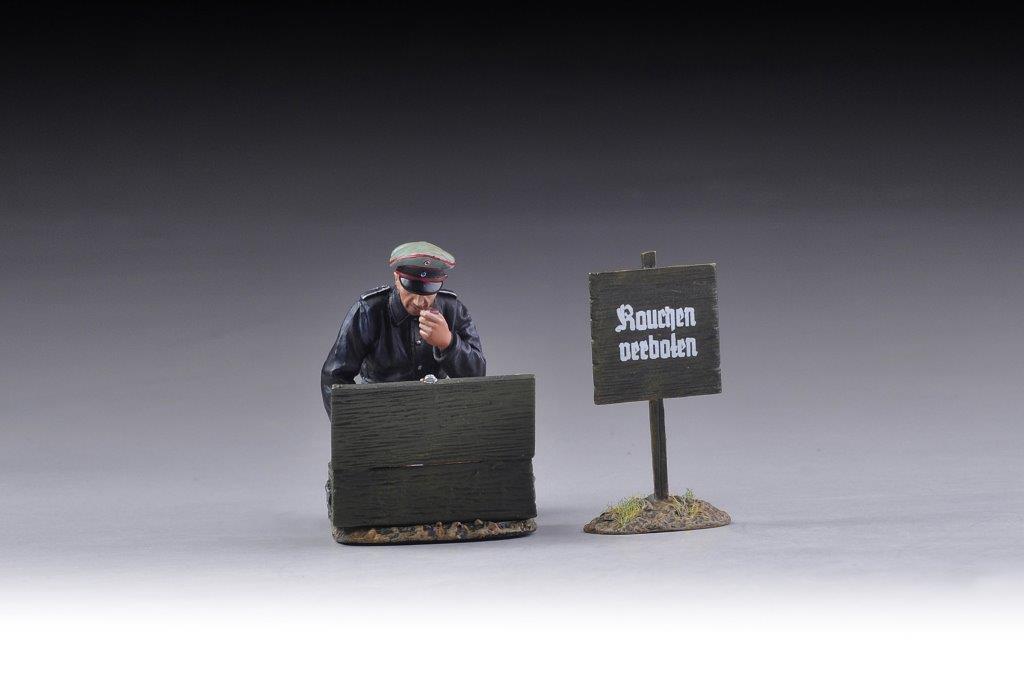
GW054 German Ground Crew/Mechanic with toolbox. A great little figure
smoking a pipe that will look suitable in any airfield diorama or maybe next
to our A7 tank carrying out some repairs? Non smoking sign also included
with this set!
Limited to 100 in number and priced at $43.50/£32

Happy Hunting!

John Jenkins Designs: New Germans

A couple of new WW1 Germans from John, and links to a couple of websites should you want a bit more info, or a full listing of all his new releases


Happy Hunting! 

King and Country: May Dispatches

So, in accordance with the new format, here are the recently released Germans from K&C, and there are quite a few I can tell you, together with the hyperlinks to the TSC and K&C websites where you can find out more information including and a complete breakdown of all the new releases. Plenty to enjoy!


To begin with, here are a couple of 'holdovers' from April that are now available for sale


Happy Hunting!

Saturday, 9 May 2015

Thomas Gunn Miniatures: April Germans

The latest German troopers from TGM


WWII German forces


  • FJ019 -- "The Breakfast Club" #2 - Two more of our popular FJ's in a relaxed mode to add to the first Breakfast Club recently issued. One FJ stands smoking a cigarette with his MG42 propped up in front of him whilst the other adopts a more casual pose resting his foot on an ammo box, note the captured Sten gun as his weapon of choice! A pan of fried egg makes a neat touch to this set. Please note that both these figures have no base and can be used as tank riders if so desired.
World War One


Happy Hunting!