Back with more delights from the Americas, this time in the shape of some 'sons of India' who fought as part of the British Army during the First World War and a few more additions to their flagship Delhi Durbar range
First up is a group of soldiers from the Indian Cyclist Corp together with one of the photos which inspired the set
In the war a number of duties befell cyclists incuding:
Courier work - sometimes cycling down communications trenches. This was
particularly important when the security of the trench telephone system
was found to have been compromised by German Moritz receiving stations
Security patrols - for example the canal system in both Britain and
France could have been very vulnerable to sabotage and was patrolled by
cyclists
In the early days of the war cyclists (British, Belgium and German) were
employed as scouts - for example contact with the Russians before
Tannenberg was first made by German cycling units. In Belgium British
and German cycling units actually engaged each other. One of the Anglo
Belgian armoured trains actually carried Belgian cycling troops on board
to scout away from the railway line
The Italians had cycling troops used as a mobile reserve to plug holes in the line in the case of an Austrian break through
 |
There were four kinds of cyclist units in the British Army of World War I.
1. The cyclist battalions of the Territorial Force, which were infantry units.
2. Yeomanry regiments of the Territorial Force that had exchanged their horses for bicycles.
3. The divisional cyclist companies of infantry divisions
4. The corps cyclist battalions of army corps |
Next up is a group of splendid looking camel riders which I'm sure many collectors would simply love to add to their DDDs! [Delhi Durbar Displays]
 |
| Alwar camel riders |
 |
| Alwar camel riders band |
 |
| Alwar camel riders band, part 2! |
The final pictures show two new elephants and attendant escort guards, musicians and standard bearers looking resplendent, as ever, in their multicoloured garb
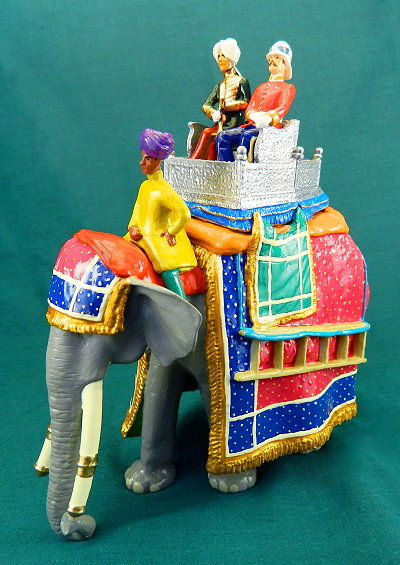 |
| The elephant of Faridkot |
 |
Faridkot State, with its capital at Faridkot, was a Princely state in Punjab region, it was one of the Cis-Sutlej states.
The state was established in 1763, ruled by a Jatt Sikh Brar
dynasty and was an offspring of Kotkapura. Faridkot was occupied by
Ranjit Singh of the Sikh Empire in 1803 but had to be returned to the former
rulers in 1807 on the behest of the British. The Faridkot Elephant was part of the Main Procession. It went on the
left column in 23rd place, beside the Limri Elephant, after the Maler
Kotla Elephant, who went alone, and before the Manipur one |
 |
| Escort Guards |
 |
| Music Group |
 |
| The Faridkot group in its entirety |
 |
| Elephant and standard bearers from Kotah |
These sets, together with everything else produced by Beau Geste, is available from Piers Christian, the sole distributor of BG merchandise in the United Kingdom. Happy hunting!